Showing posts with label safety. Show all posts

Monday, March 20, 2017

Blackmon Drive to become right-out only at Scott Blvd.

March 20, ~4pm: road closed for sign installation.  
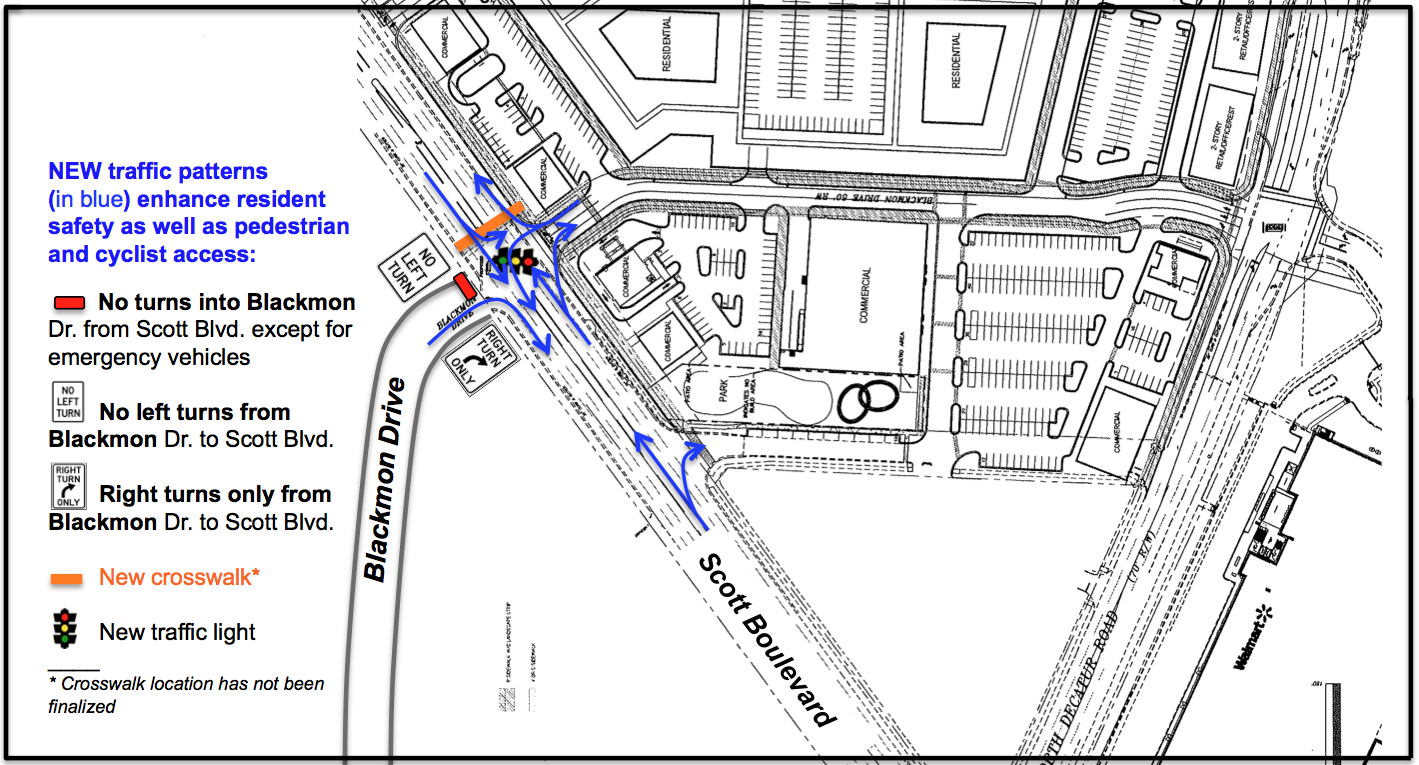
Work has begun to make Blackmon Dr. a right-out only turn at Scott Blvd. This means that
  • there will be no access to Blackmon Dr. and the Medlock neighborhood from Scott Blvd. except for emergency vehicles, and
  • there will be a new crossing light to facilitate pedestrian access between the neighborhood and the new developments at Decatur Crossings.
We are not sure when work will be completed. The installation of the crossing light started today (March 20) and likely will take several days. It would be best to avoid the intersection and be extra-aware of traffic in the general vicinity over the next few days, as there is bound to be some confusion.
UPDATE: Fuqua Development has informed us that the project should take ~10 days to complete, and paving should be completed by Friday. There will be a 20-day "flashing burn-in" period (to alert drivers to the changes) but the intersection will be operational during that period.

As discussed in this July 2015 post that summarized negotiations with Fuqua Development, this change in traffic pattern was negotiated "to eliminate right turns into the neighborhood from west-bound traffic during the morning rush hour as well as greatly reduce afternoon traffic using Blackmon to exit the neighborhood."

Blackmon Drive is a narrow and curving road that has been handling unsafe levels of traffic for quite some time. Reducing traffic and adding a crossing light should create a safer access point for pedestrians and cyclists in the area (relative to braving the 6-way intersection at Medlock Rd./Scott Blvd./N. Decatur Rd., that is).

We are not exactly sure what the finished product will look like, but it should function as outlined in the image below.
New traffic patterns at the Blackmon and Scott Blvd intersection. Click to enlarge.
Below, the new crosswalk seen in the context of new, nearby commercial and residential (re)developments.

Thursday, January 23, 2014

Cyclists and pedestrians: be bright!

"The Governor's Office of Highway Safety is urging cyclists and pedestrians to wear reflective gear. 
GOHS officials say there were more than 130 pedestrian fatalities in 2012 and the number accounted for about 11 percent of all traffic deaths that year. Authorities say a majority of cyclist and pedestrian fatalities on a national level happen at night. Officials say about 32 percent happen between 8 p.m. and midnight, and 24 percent happen between midnight and 4 a.m."  Read the rest @ CBS Atlanta
For additional safety tips, visit the Georgia Governor's Office of Highway Safety.

Thursday, October 31, 2013

Halloween Safety

Safety tips from America's favorite candy pushers!


Also see additional safety tips from Consumer Reports.


Tuesday, September 3, 2013

North Decatur Road Safety Audit: Community Meeting to Discuss Recommendations [Sept. 26]

As noted elsewhere, concerned citizens and local organizations have come together to conduct a road safety audit of North Decatur Road.

The recommendations from the audit will be unveiled on September 5.

The next step in the process is to invite comments from the community in response to these recommendations. Joe Greear asked MANA to help schedule a venue for this meeting, during which Commissioner Rader, DeKalb County traffic planners, Bike Emory and the Atlanta Bicycle Coalition will present the audit and discuss what the County can do to make N. Decatur safer.

This meeting is now scheduled for
September 26
7pm
Fellowship Hall of North Decatur Presbyterian Church
611 Medlock Road
Decatur, GA 303022

Wednesday, August 28, 2013

Road Safety Audit Report [Sept. 5]


Road Safety -- North Decatur Road (Part II)

Share and share alike: room for everyone on North Decatur Road.
Here are some info nuggets from the July 29 workshop:
  • Many of our road standards (e.g., sign height) are relics of the original studies conducted in the 1950’s. Consider 1950’s road conditions, vehicles (size, materials) vs today’s cars and driving habits.
  • Pedestrian deaths are proportional to impact speed. A 20 mph impact has a 5% death probability for the pedestrian; at 30 mph, those odds go to 45%; at 40 mph, 85%. {Thanks to Marian at PEDS for correcting the above figures and adding that "It’s amazing that doubling one’s speed means a seventeen-fold increase in risk of fatality and also speaks to why we at PEDS are so focused on getting drivers to slow down. More information on speeding in urban and residential districts can be found on our website: http://peds.org/issues/reduce-speed-limits/."}
  • Intersections are the most dangerous place for pedestrians.
  • Most people have trouble judging distances, and people tend to drive at what they consider a “comfortable” speed (as opposed to the posted speed limit). The combination—a speeding driver who overestimates his/her ability to stop—is deadly. 
  • Cyclists: riding against traffic is dangerous because it places the cyclist in an area outside the driver’s expectation.
  • EVERYONE is a pedestrian at some point: while getting out of a car in a parking lot, while leaving a bus or building. Of the US’s ~300 million population, around ~200 million hold drivers licenses. Children, the elderly and the impaired are often, by necessity, pedestrians.
  • Crossing lights are timed to a 3.5 foot/second standard (the old standard assumed people would walk at ~4 foot/second). Not all individuals are able to travel at this idealized speed, which means they may not have enough time to cross even when they use crosswalks correctly. 
  • If foot traffic is vital to business, protect foot traffic.  
  • The young and the elderly have slower reaction times than adults. 
  • The young and the elderly have limited peripheral vision (30% less) relative to adults.
  • Intersections are dangerous. The biggest number of crashes at intersections are due to left turns, with right turns being the second most dangerous turn.
  • Crash sources: ~64% are human factors, ~28% are due to road/environmental conditions, ~9% are due to vehicular malfunctions.
human factors [drivers go too fast, drivers are stressed during commutes, drivers allow themselves to be distracted by their cell phones (talking or texting/browsing web)] 
+   
environmental factors (drivers may not notice they are picking up speed on the downhill; limited visibility due to topography, weather, light conditions; tunnel vision due to distractions)  
North Decatur Road at rush hour is a minefield... 
  • Maintenance is one of the first things that suffer during budget cuts. Overgrowth of vegetation can create road hazards.
  • With regards to cyclist fatalities, roads without bike lanes pose the highest danger. Sidewalk riding increases the risk of crashes. 
  • Bikes belong in highways unless prohibited.
  • An ideal bike lane (one way) is 4’ wide.  When a bike lane is added next to a parking lane, the overall lane width should be 12’ (to shelter cyclists from car doors that suddenly swing open). A 10-11’ lane can be equally safe, if posted speeds are 45mph or less. 
  • North Decatur Road moves around 19,000 vehicles/day. Likely solutions for existing situations include a road diet or reversible lanes.
  • For pedestrian safety: make eye contact with drivers and never assume that  “waving” signifies that the whole passage (across whole roadway) is safe. 
  • Faster speeds and busy roadways create tunnel vision for the driver. The busier the road and the faster the speed, the smaller the area that the driver is aware of (peripheral perception suffers!).
Links from the presentation: a treasure trove!

Walkinginfo.org: Pedestrian and Bicycle Information Center
Includes a report titled Road Diet Conversions: A Synthesis of Safety Research (May 2013)
"The primary purpose of this review is to assess the available evidence regarding the safety effectiveness of reductions in the number of motorized traffic lanes, widely known as road diet conversions. Although road diets have been implemented since at least the 1970s, earlier reviews and a search of the literature identified no controlled safety evaluation studies conducted prior to the year 2002. A systematic search of literature dating from 2002 was conducted. Six studies in total were initially identified, with four serving as the basis for most conclusions in this review."
This site also includes the PBCAT (Pedestrian/Bike Crash Analysis Tool).

APBP (Association of Pedestrians and Bicycle Professionals)
Includes the Women Cycling Project and the Bicycling Parking Guidelines document [pdf]

NCHRP (the National Cooperative Highway Research Program)
Want to know the outcomes of research projects funded by the Transportation Research Board of the National Academies? Check out the project list.
"The National Cooperative Highway Research Program (NCHRP) conducts research in problem areas that affect highway planning, design, construction, operation, and maintenance nationwide"
PEDSAFE (Pedestrian Safety Guide and Countermeasure Selection System)
Don't miss their recommendations for sidewalks/walkways, crosswalks, or their case studies (featuring examples grouped by state/country and also by countermeasures--great set of examples of what's available).
"The Pedestrian Safety Guide and Countermeasure Selection System is intended to provide practitioners with the latest information available for improving the safety and mobility of those who walk. The online tools provide the user with a list of possible engineering, education, or enforcement treatments to improve pedestrian safety and/or mobility based on user input about a specific location."
BIKESAFE (Bicycle Countermeasure Selection System)
Yet more great info, including crash factors.
The Bicycle Countermeasure Selection System (BIKESAFE) is intended to provide practitioners with the latest information available for improving the safety and mobility of those who bicycle. The information on the site falls into two categories, Resources and Tools
US Department of Federal Highway Administration's Safety Program
"The focus of the FHWA Safety Program is to ensure safer roadways The FHWA Office of Safety works with Federal, State and Local partners and others in the transportation community to develop and promote programs and technologies to improve the safety performance of our Nation’s roadways to reduce the number of fatalities and injuries (safety facts). Safety should be integrated into all programs and projects and considered every time and during every stage from development to completion.  This office provides decision-makers the tools, resources, and information necessary to make sound safety investment decisions."
National Highway Traffic Safety Administration
Don't miss the "Everyone is a pedestrian" section.
"NHTSA was established by the Highway Safety Act of 1970 and is dedicated to achieving the highest standards of excellence in motor vehicle and highway safety. It works daily to help prevent crashes and their attendant costs, both human and financial."
Institute of Transportation Engineers

Safe Routes to School
With Druid Hills High School being so close to North Decatur Road, that's another reason to focus on pedestrian and cyclist safety.

CDC's Pedestrian Safety site.

Tuesday, August 27, 2013

Road Safety -- North Decatur Road (Part I)

On July 29, I attended the Roadway Safety Audit (RSA) Workshop introduction organized by Bike EmoryEmory’s Rollins School of Public Health, and the Atlanta Bicycle Coalition. The workshop was ably led by Craig Allred, FHWA Resource Center Technical Specialist.

RSA's are a formal process through which community members are trained to (1) recognize safety challenges that a particular section of roadway poses for pedestrians and cyclists, and (2) propose improvements or modifications that enhance safety and access for all. The resulting audit (observations and suggested improvements) is shared with local authorities and other stakeholders (e.g., developers, institutions, local government) who are in a position to secure funds and implement improvements. Local government typically issues a written response to the audit.

image via Googlemap
This workshop was a preamble to an audit being conducted for the section of North Decatur Road between Clifton Road and Church Street. It was attended by several GA DOT employees, several City of Decatur employees, and Commissioner Jeff Rader. The impetus for the workshop comes from recent pedestrian and cyclist fatalities on North Decatur Road. Ghost bike and ghost chair memorials had been installed near the location of these fatalities (corner of North Decatur Rd. and Superior Ave.) by family, neighbors and friends of the victims; these memorials were removed by unknown parties on August 26.

Joe Greear (Clairmont Heights resident) has been very active in bringing these safety concerns to the fore and participated in the North Decatur Road RSA. He shares this message:
...I participated in a Road Safety Audit focused on pedestrian and bicycle traffic on N. Decatur Road. The audit was sponsored by the Atlanta Bicycle Coalition (ABC), Emory University School of Public Health, and Bike Emory and was led by a Transportation Safety Specialist from the Federal Highway Administration. The audit team included members of ABC, Bike Atlanta, PEDS, DeKalb County traffic engineering, our county commissioner, and members of the local community. We spent two days studying the conditions along N. Decatur from Clifton Rd. to Church street. The team traveled this stretch of road several times, reviewed daily traffic counts, crash data, and traffic flow. We then brainstormed solutions and will develop a report with recommendations by mid September.  
I am confident that the recommendations will be both feasible and effective. The Safety Specialist from FHWA is experienced in developing solutions for situations just like ours and presented several examples of solutions from around the country. I don't want to get into the details yet, but some of the items that MAY end up in the recommendations include road diet measures, sidewalk improvements, additional crosswalks, and repaving N. Decatur. Please hold comments until the final report is made available. 
I hope to present the report (with the help of ABC and Bike Emory) to our neighborhood associations in a community meeting. At the presentation I would like to begin a petition drive to request that our county officials implement ALL of the recommendations in the report. 
You may have noticed the PEDS “Slow Down” signs along North Decatur Road. That was the work of Joe Greear and Deanne Thomas, Mary Shellman and Meck Stockman. Thanks, y’all ☺

So please drive the speed limit and be a pace-setter! As soon as the audit is complete and ready for sharing, we will schedule a meeting venue and being the petition drive.

UPDATE: Mr. Fred Boykin, City of Decatur Commissioner and owner of Bicycle South, posted on the DecaturMetro blog (comment section) that the results of this RSA will be shared on September 5.